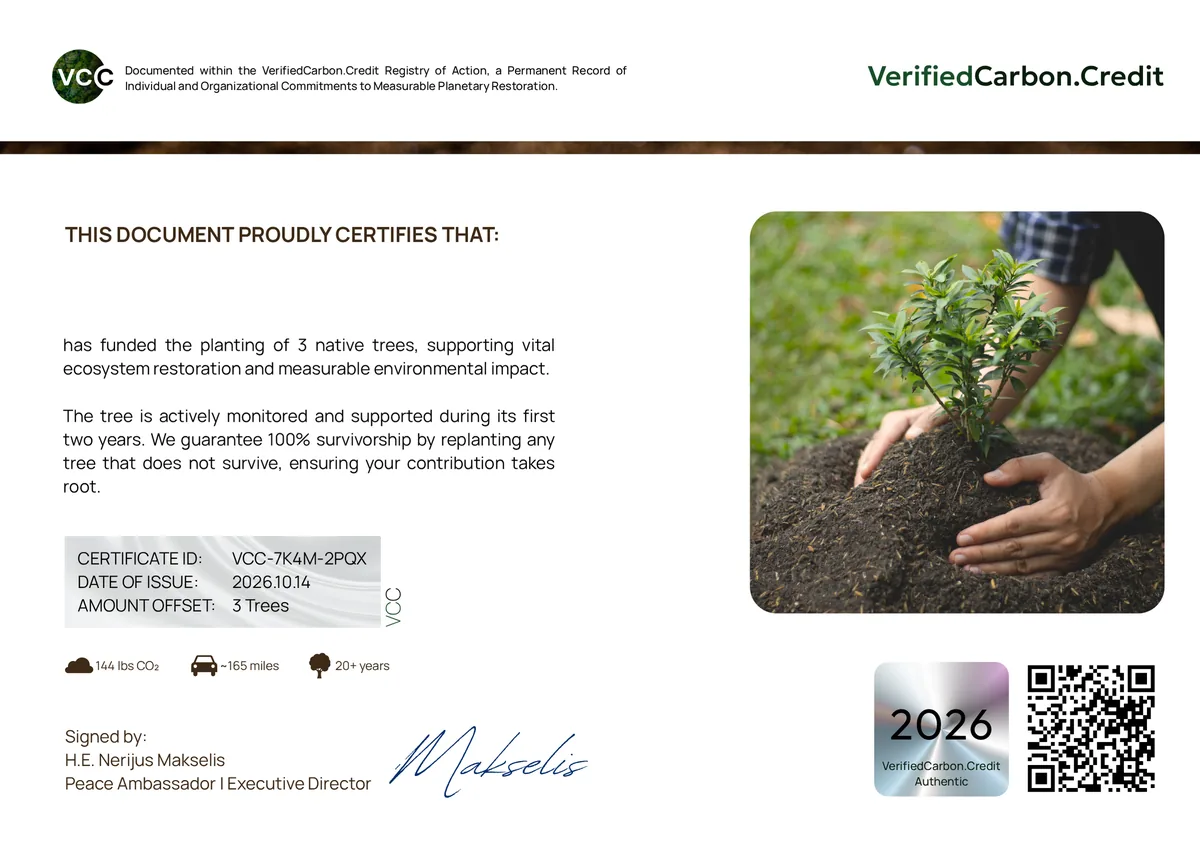
How many trees does it take to offset a ton of CO₂?
It’s one of the most searched questions about trees, and most answers give you a single number. The honest answer is a range — but the math is simple once you see it.
The short answer
A growing tree takes in somewhere between 10 and 40 kilograms of CO₂ a year, depending on its species, age, soil and climate. A widely used round figure for a healthy, established tree is about 25 kg (55 lb) a year.
One metric ton is 1,000 kg. So, using that round figure:
That’s the headline. The rest of this article explains why the number moves around, and why “how many trees?” is only part of the story.
How a tree actually stores carbon
Trees build their trunks, branches and roots out of air. Through photosynthesis, leaves take in carbon dioxide, keep the carbon, and release the oxygen. Roughly half of a tree’s dry weight is carbon.
There’s a neat bit of chemistry here: because each carbon atom pairs with two oxygen atoms in CO₂, every kilogram of carbon stored in wood corresponds to about 3.67 kg of CO₂ taken from the air. That’s why a heavy, dense trunk represents a surprising amount of CO₂.
Why the number varies so much
Age matters most
A seedling is tiny. In its first few years it takes in only a few kilograms of CO₂ a year, because there’s simply not much of it yet. Growth speeds up as the tree gets bigger, then levels off as it matures. A newly planted tree won’t hit 25 kg a year on day one — it gets there over time.
Species and place
Fast-growing trees in warm, wet places add wood quickly. Slow-growing trees in cold or dry places add it slowly, but some of them live for centuries and end up storing a great deal. A tropical tree and a northern pine planted on the same day can have very different numbers.
Survival
Not every seedling makes it. Drought, grazing animals and pests all take a toll in the early years. That’s why serious planting projects check on their trees and replace the ones that fail. We check every tree we plant for two years and replant any that don’t survive.
A useful way to think about it: one tree is a slow, steady saver. It does most of its work over decades, not in its first year.
What does a ton of CO₂ look like?
It helps to picture it. At everyday temperature and pressure, one metric ton of CO₂ fills about 556 cubic meters — a cube roughly 8.2 meters (27 feet) on each side, taller than a two-story house.
Slide to see how your cubes stack up over a year. The house is to scale.
For context, the average American is responsible for a bit more than a ton a month across driving, home energy, food and the things we buy. We break that down in what one month of carbon looks like.
Trees and carbon credits are two different tools
This is where a lot of confusion starts, so it’s worth separating them:
- Planting new trees adds carbon storage slowly, over many years. It also brings shade, soil protection and habitat for wildlife.
- Protecting existing forests keeps carbon that’s already stored in mature trees from being released when a forest is cleared. A verified carbon credit from a forest-protection project represents one ton of CO₂ that stayed out of the air, checked by an independent auditor.
Because a new seedling takes decades to absorb a ton, it isn’t honest to say “plant one tree and you’ve offset a ton today.” That’s why we keep the two separate: our monthly offset uses verified, retired credits for an immediate ton, and our tree plantings are about growing new forest over time.
“A seedling is a promise. A protected forest is carbon already in the bank. Both are worth having.”
So, how many trees should you plant?
If your goal is to absorb a specific amount of CO₂ in a specific year, trees alone are a slow way to get there. If your goal is to leave a place greener than you found it, with benefits that grow every year, trees are hard to beat.
Many people do both: they cover their month with a verified credit, and they plant trees for the long run.
Common questions
How much CO₂ does one tree absorb in a year?
Typically between 10 and 40 kg, depending on species, age and conditions. About 25 kg is a common round figure for an established, healthy tree. Young seedlings absorb much less.
How many trees would offset an average American’s yearly footprint?
With a footprint of roughly 15 tons a year and 25 kg per tree per year, you’d need around 600 established trees working for a full year. That’s why trees are usually paired with other approaches.
How long does it take a tree to absorb one ton of CO₂?
At around 25 kg a year, about 40 years for a single tree — longer for slow growers, shorter for fast growers in good conditions.
Do older trees absorb more CO₂ than young ones?
Generally, yes. Bigger trees add more wood each year. Mature forests also hold very large stores of carbon, which is why protecting them matters.

Your name