How to tell if a carbon credit is the real thing
Carbon credits have had their share of bad headlines — some of them deserved. The good news: you don’t need to be an expert to tell a solid credit from a weak one. Here are seven plain questions to ask.
First, what is a carbon credit?
A carbon credit represents one metric ton of carbon dioxide (or the equivalent in other gases) that was kept out of the air or removed from it. Projects that do this — protecting a forest that was going to be cleared, for example — have their results measured and checked, and are then issued credits.
When someone uses a credit to cover their own emissions, the credit is retired: permanently cancelled on a public registry, so it can’t be sold or claimed again.
That’s the theory. Whether a specific credit lives up to it depends on the answers below.
The 7-point checklist
1. Is it from a recognized standard?
Credits should be issued under an established program with published rules. Well-known ones include Verra (Verified Carbon Standard), Gold Standard, the American Carbon Registry and the Climate Action Reserve. These programs set the methods projects must follow and keep the registries where credits are tracked.
2. Was it checked by an independent auditor?
The project shouldn’t be grading its own homework. Look for third-party verification: an accredited auditor that reviews the project’s data and confirms the results before credits are issued.
3. Is it additional?
This is the big one. Additionality asks: would this have happened anyway? If a forest was never at risk, paying to “protect” it doesn’t change anything. A good project shows a believable threat and explains why the funding makes the difference.
4. Is the baseline realistic?
Every project compares what happened against what would have happened. That comparison is the baseline. If the baseline is exaggerated, the project claims more tons than it really delivered. Conservative, regularly updated baselines are a good sign.
5. Will it last?
Permanence is about whether the benefit sticks. A protected forest could still burn or be logged later. Strong programs handle this with long-term commitments, monitoring, and a buffer pool — a reserve of credits set aside to cover losses if something goes wrong.
6. Does it just move the problem?
Leakage happens when protecting one area simply pushes clearing to the next valley over. Good projects measure and account for it, so the tons they claim are real tons overall.
7. Can you see it retired in your name?
This is the step you can check yourself. A legitimate credit has a serial number on a public registry, and when it’s used for you, it should be retired on your behalf — not just “allocated” in a company spreadsheet. If you can’t see the retirement, you can’t be sure it isn’t being counted twice.
Short version: recognized standard, independent audit, additional, realistic baseline, lasting, no leakage, and retired in your name. If a seller can explain all seven in plain words, that’s a very good sign.
Red flags to watch for
- Prices that seem too good to be true. Very cheap credits are sometimes cheap for a reason.
- No project name or location. You should be able to find out what you’re supporting.
- No serial numbers or registry links.
- Vague language like “we partner with projects worldwide” with nothing specific behind it.
- Claims of instant tons from new trees. Newly planted trees absorb carbon slowly over decades. We explain why in how many trees offset a ton.
How we handle it
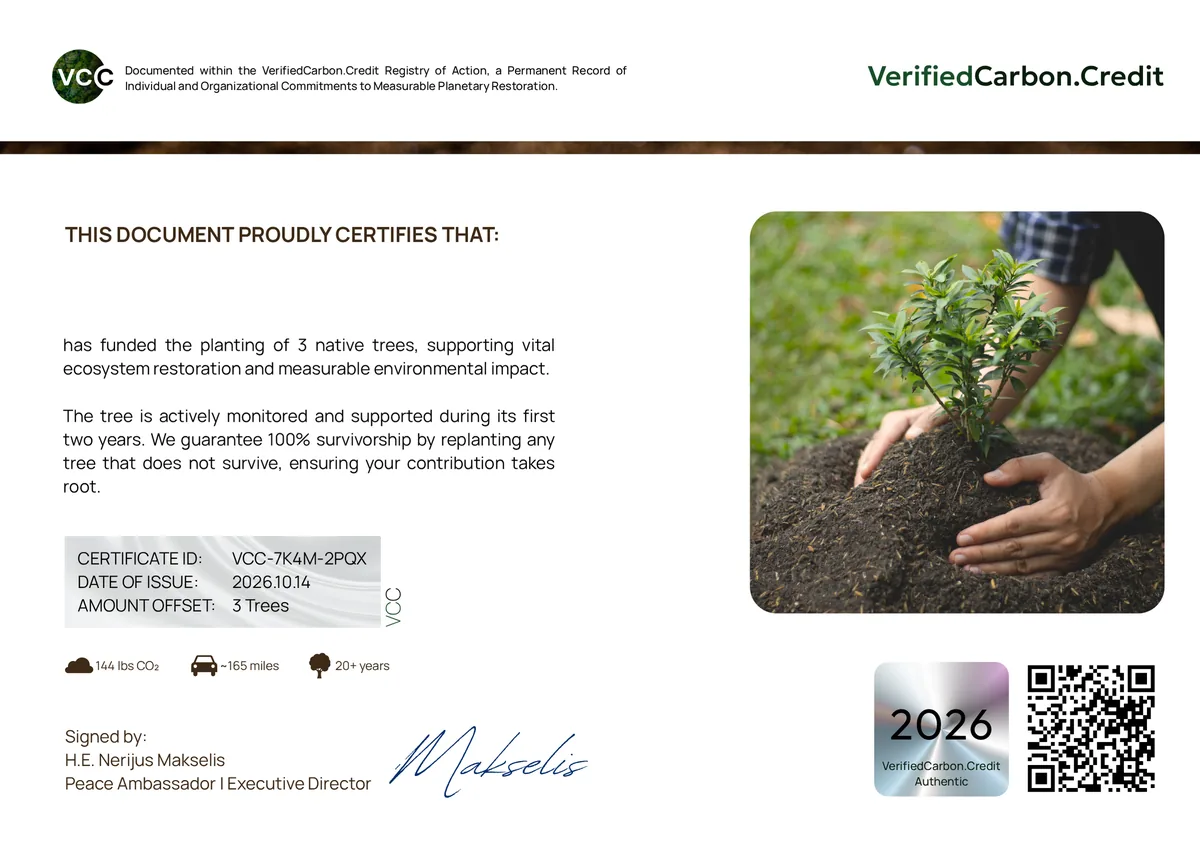
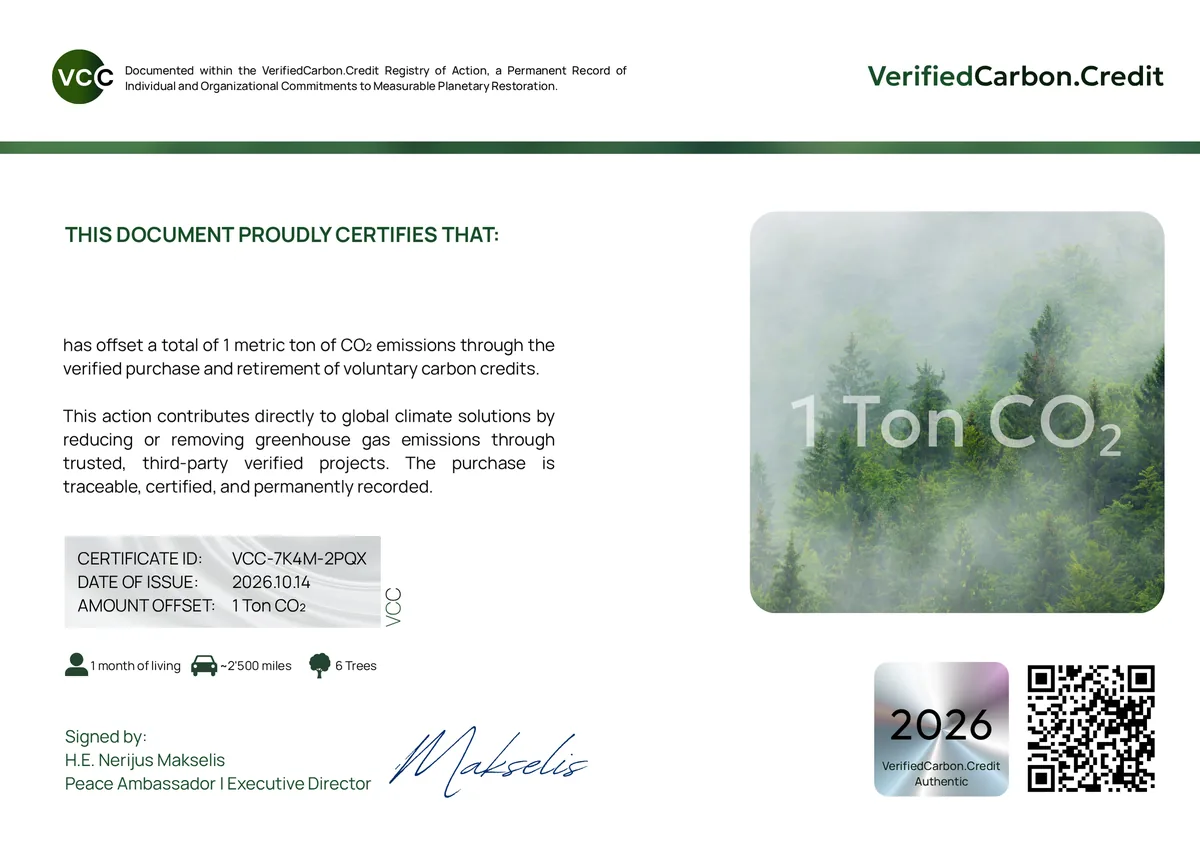
We buy verified credits from forest-protection projects, checked by independent auditors — not by us. Each credit we use for a customer is retired in that customer’s name, and their certificate gets its own ID. Anyone can type that ID on our verify page to see the record. No login, no fine print.
“Trust shouldn’t be a leap. It should be something you can check in ten seconds.”
The bigger picture
Industry groups have been working to raise the bar. For example, the Integrity Council for the Voluntary Carbon Market published its Core Carbon Principles in 2023, a shared benchmark for credit quality. Standards will keep improving, and that’s a good thing for everyone who buys credits.
In the meantime, the seven questions above will get you most of the way.
Common questions
What does it mean when a carbon credit is retired?
It means the credit has been permanently cancelled on a public registry, so no one else can sell it or claim it. Retirement is what turns a credit into an actual offset for a specific person or company.
What is additionality in carbon credits?
It’s the test of whether a project’s results would have happened without the credit funding. If they would have happened anyway, the credit doesn’t represent a real change.
How can I verify a carbon offset certificate?
Look for a certificate ID or serial number you can check on a public page or registry. For our certificates, enter the ID on our verify page or scan the QR code.
Are forest protection credits legitimate?
They can be, when the forest was genuinely at risk, the baseline is realistic, and permanence and leakage are handled properly. That’s why independent verification matters.
Your name